
Ahead of the upcoming elections, political parties have started announcing incentives to benefit women, but what do women truly seek for genuine gender parity, asks Nivedita Mookerji.

Karnataka health minister Dr K Sudhakar on Monday said his statement on modern women unwilling to marry and bear children at an event in NIMHANS was taken out of context and that he had no intention of singling out women and it was based on a survey, which cited statistics on what the younger generation felt about it.

rediffGURU Anu Krishna explains how you can improve your mental health by seeking professional help.
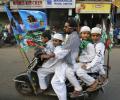
The rate of immunisation is low mainly because of rumours that the vaccines would have a sterilising effect on the children.

'Modi must see how we live, what we have to do to educate our children.'

The report highlights that India's population in 2036 is expected to be more feminine compared to the 2011 population, as reflected in the sex ratio which is projected to increase from 943 in 2011 to 952 by 2036, highlighting a positive trend in gender equality.
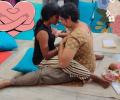
A birthing centre in Bengaluru is helping women make informed decisions about their pregnancy, right down to choosing how they have their baby.

'Sexual violence against women is not something unique to India but in our parts the victim must also have to contend with other burdens. Such as the notion of 'honour' and its loss,' says Aakar Patel.

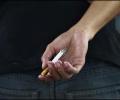
Some cigarette-smokers may switch to beedis, or gutka, which is probably not the outcome the health ministry wants.

For the Mizo people, tribal and family identity are important. But so are jobs, farmers' access to markets, roads, and health facilities for a young population where drugs are a big affliction.

Under the Pradhan Mantri TB Mukt Bharat Abhiyan, an initiative of the government, more than 40,000 Nikshay Mitra are supporting over 10.45 lakh TB patients all over the country presently, the Union health ministry said.
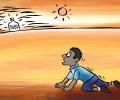
'When manufacturing or even services cannot generate the kind of employment they are looking for, they prefer to be unemployed rather than under-employed.'
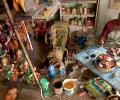
India was ranked 70th of 77 countries in the Female Entrepreneurship Index 2015 released by London-based Global Entrepreneurship Institute
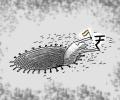
Claims of a spike in poverty and inequality in India during the Covid-19 pandemic are patently false as such claims are based on uncomparable different surveys, according to a paper co-authored by eminent economist Arvind Panagariya. The paper also noted that inequality fell in the country during Covid years, both in rural and urban areas as well as nationally. Panagariya, Columbia University Professor and former vice chairman of NITI Aayog and Vishal More of Intelink Advisors, New Delhi have co-authored a detailed paper 'Poverty and Inequality in India: Before and After Covid-19'.

'The government should act proactively to instil confidence in the private investors, and also boost the purchasing power of people directly or indirectly by ensuring minimum wages.'
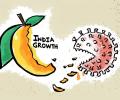
'In the real economy, the scars of the pandemic will continue to define 2021.' 'It is still hard to tell the effect on unemployment, migrant workers, poverty, and the informal sector of the lockdown and of the pandemic,' observes Mihir S Sharma.

'The government should immediately enact an Act to make caste discrimination a criminal offence and lay down a procedure similar to that of the Anti-Ragging Act.' 'Ragging has nearly been eliminated because it is treated as a criminal offence.' 'Similar procedure should be used in case of caste discrimination.'
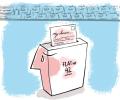
'Letter From A Stranger, India' is helping many rediscover self-worth and self-love,
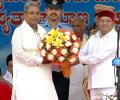
Why did Karnataka's economic prosperity fail to influence the nature of electoral promises made by political parties in the run-up to the assembly elections? asks A K Bhattacharya.

When was the last time we heard this government speaking of the disaster in primary education, rather than Ganga cruises and cheetahs? Less money -- Rs 88,000 crore -- was spent by the Union government on education in its last Budget than has been allocated to the Bullet train, notes Aakar Patel.

The 78-year-old Naveen is on the cusp of creating history. He must win the forthcoming Assembly polls to become India's longest-serving chief minister, a record held by Sikkim's Pawan Kumar Chamling.

Shobha Warrier/Rediff.com travels to Pullampara to discover how it became India's first digital literate village.

Indian billionaires saw their combined fortunes more than double during the COVID-19 pandemic, and their count shot up by 39 per cent to 142, while the wealth of the ten richest is enough to fund school and higher education of children in the country for 25 years, a new study showed on Monday. In its annual inequality survey released on the first day of the World Economic Forum's online Davos Agenda summit, Oxfam India further said that an additional one per cent tax on the richest 10 per cent can provide the country with nearly 17.7 lakh extra oxygen cylinders, while a similar wealth tax on the 98 richest billionaire families would finance Ayushman Bharat, the world's largest health insurance scheme, for more than seven years. The COVID-19 pandemic saw a huge rush for oxygen cylinders and insurance claims during the second wave last year.

We asked colleagues, present and past, to reflect on a man who has made such a difference to their lives and careers. Here it is then, a rich collection of memories that offer enchanting glimpses of the enigmatic Ajit Balakrishnan.
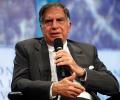
'What's sad today is that there are so many people who cannot find work, not because the country is devoid of that opportunity, but because we are not doing enough in the country.'

The challenge ahead for central and state governments remains enormous.
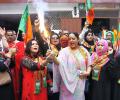
'The tragedy with Indian Muslims is that they do politics from the heart, not from the head.'

'During every election, the Gandhis come and inaugurate some projects and then leave without completing it.'
An overwhelming majority of Indians (84 per cent) feel it is safe to return to their workplaces, according to a Deloitte survey that suggests consumers in India are showing a positive spending intent and brighter outlook towards the future. The latest monthly analysis (wave 220) of Deloitte's Global State of the Consumer Tracker, signals a cautious consumption revival in the country, aided by the decreasing number of Covid-19 cases and an improved vaccination drive. The Global State of the Consumer Tracker is an online survey based on responses from 1,000 people each in 18 countries including India.

Since 1993, when the BJP came to power after a stint of President's rule, the state has alternated between the Congress and the BJP.

Anik Jain, founder and CEO at Symbo, will answer your questions on insurance -- life, health, motor, travel, etc -- on a weekly basis.

The richest one per cent in India now own more than 40 per cent of the country's total wealth, while the bottom half of the population together share just 3 per cent of wealth, a new study showed on Monday.

"Coming festivals (Chhat, Puja, Dussehra, Deepavali, Id, Xmas, New year) pose a huge challenge in the pandemic control. It has been seen that Onam in Kerala and Ganesh Chaturthi in Maharashtra escalated the pandemic seriously. This must not be allowed to happen in Delhi," the report stated.

The richest one per cent in India now own more than 40 per cent of the country's total wealth, while the bottom half of the population together share just 3 per cent of wealth, a new study showed on Monday. Releasing the India supplement of its annual inequality report on the first day of the World Economic Forum Annual Meeting in Davos, rights group Oxfam International said that taxing India's ten-richest at 5 per cent can fetch entire money to bring children back to school. "A one-off tax on unrealized gains from 2017-2021 on just one billionaire, Gautam Adani, could have raised Rs 1.79 lakh crore, enough to employ more than five million Indian primary school teachers for a year," it added.

The pandemic has changed the way people see the government. It has eroded trust in the administration's ability to tackle a crisis, any crisis, observes Devangshu Datta.

Deane De Menezes hopes to reduce the awkwardness and stigma around menstruation.

With schools closing down, many girls and their female family members in rural and urban areas now don't have access to sanitary pads.

Nearly 3.64 lakh educated and "semi-educated" youngsters had registered with employment exchanges across Gujarat till December 2021, according to state government data.

I suggest we build a Vigyan Mandir (Temple of Science) with the ambience of a place of worship, so that it becomes a destination for pilgrims. We should embed on its walls bronze plaques describing each scientist mentioned here along with about a dozen of our ancient mathematicians, recommends Professor Kalyan Singhal, historian of science and technology.
